
First Period Toolkit: What to Tell Your Daughter (And What Nobody Told You)
A warm, honest guide for navigating the first period conversation, from the puberty signs to the practical kit.
By Freya Willams, Women's Health Guide
Published May 2026 • United Kingdom
When your daughter's first period arrives, you want to be prepared, and you want her to feel like it's no big deal, even if you're quietly panicking. Most of us are working from a script we didn't choose: a vague chat at school, a leaflet from the GP, possibly a slightly mortified mother of our own doing her best.
The good news is that you don't need to be a perfect source of information. You just need to be a calm one, with a few practical things in place and the right tone. Here's a starter toolkit for the conversation, the kit, and the curveballs.
When it's likely to happen
In the UK, the average age for a first period (medically known as menarche) is around 12 to 13, with anywhere between 9 and 16 considered normal. NHS guidance is clear that there's no "right" time, and the range is genuinely wide. Some girls start in primary school. Others won't start until well into secondary school. Both are fine.
If your daughter hasn't started by 15 or 16, it's worth a low-key conversation with the GP. Early periods (before age 8) also warrant a chat with a doctor, but for most families, the wait sits somewhere in the middle and the main job is just being ready.
Signs to watch for in advance
Periods usually start about two years after the first signs of puberty, and there are some helpful early markers:
Breast development begins (usually 18 months to 2 years before the first period)
Pubic and underarm hair appears
A growth spurt, often followed by it slowing down
A white or clear vaginal discharge appearing in her underwear (this typically shows up around 6 to 12 months before her first period and is one of the most reliable signs that it's getting close)
That last one is genuinely useful. If you notice she's mentioning a discharge or you're seeing it in the laundry, it's time to have the kit ready, not panic-bought from a Tesco at 9pm.
What to have at home before it starts

Keep things simple. You don't need everything at once.
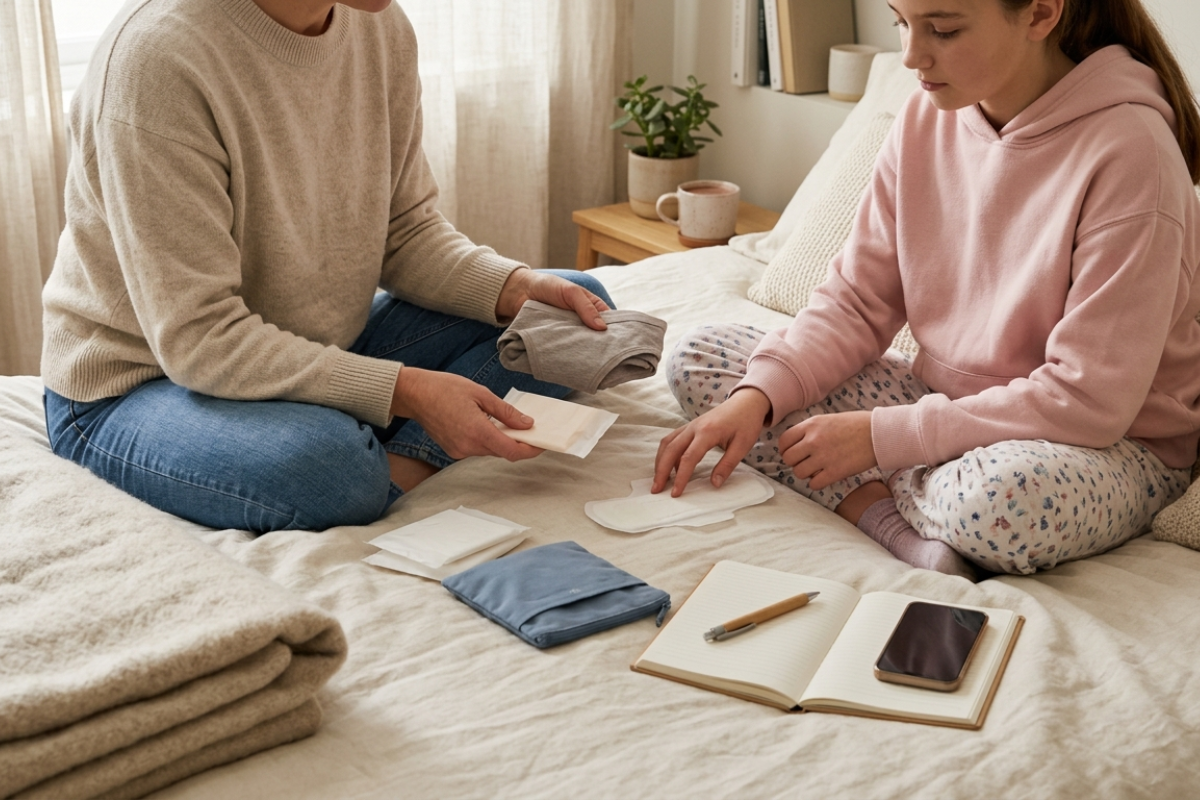
Pads are usually the easiest place to start.
They're external, they don't require any insertion, and they're straightforward to use without any practice. Get a small variety pack so she can find what feels comfortable: regular, super, and night-time. Both stick-on disposable pads and reusable cloth pads work well for beginners.
Period underwear is brilliant as a backup or for overnight.
It looks like normal knickers, holds a few hours' worth of flow, and is much less stressful than waking up at 3am wondering if you've leaked. Having a couple of pairs in her drawer before her first period means she has options when day one rolls around.
Tampons and other internal products can come later.
There's no rush to introduce tampons, menstrual cups, or discs. Most girls find them easier to consider once they've had a few periods and feel familiar with their flow. When she's ready, tampons with a smooth applicator and the lowest absorbency suitable for her flow are the easiest starting point.
A small "just in case" kit for her bag or locker.
A discreet pouch with two pads, a clean pair of knickers, and a few wet wipes covers most surprises at school. Make it once, restock occasionally, and it removes a huge amount of anxiety.
What to say (and how to say it)
The framing matters more than the script. A few principles that tend to land well:
Treat it as normal, not as A Big Event. Casual works better than ceremonious for most girls. "This is just something your body does" beats a formal sit-down chat.
Make it factual first, emotional second. Explain what's happening (the uterus shedding its lining, roughly every 28 days, lasting around 3 to 7 days) before getting into feelings. Mystery breeds anxiety.
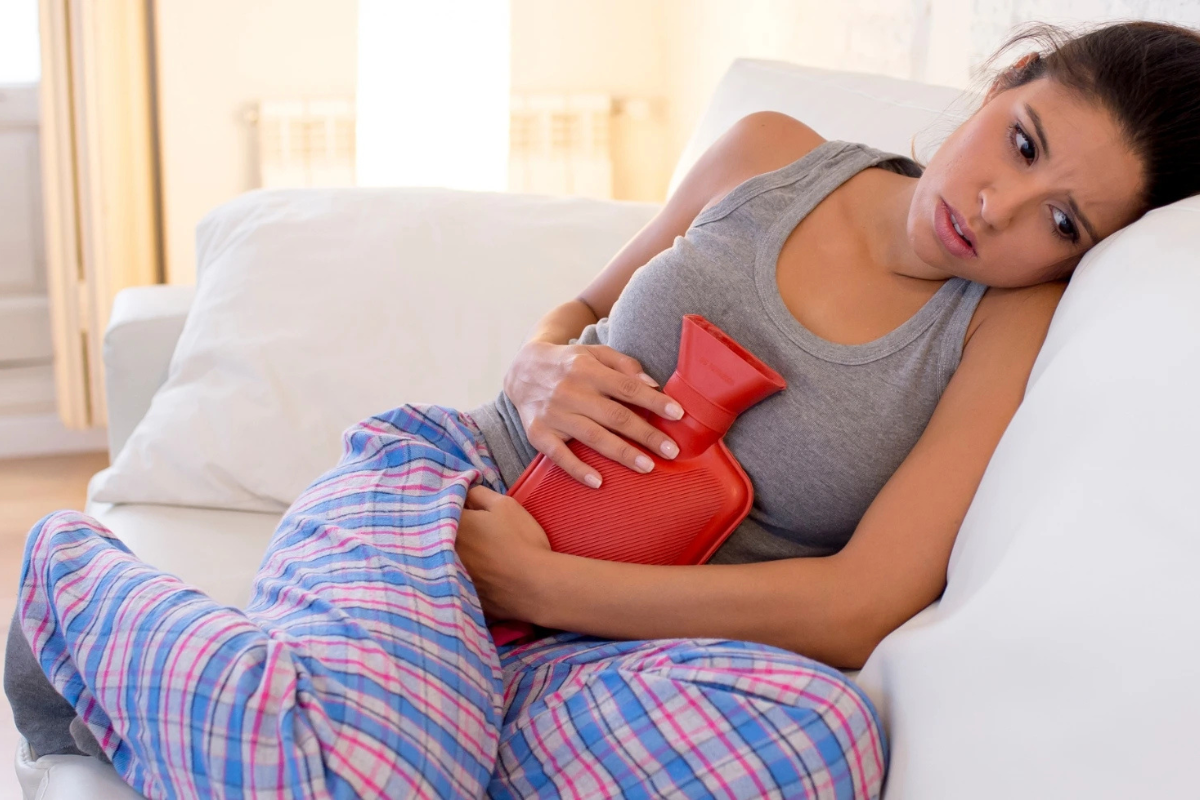
Tell her what to expect physically. Cramps, bloating, mood changes, fatigue, and sometimes feeling more emotional are all part of it. Naming these in advance means she won't think something's wrong with her when they happen.
Make it clear she can come to you any time, with anything. Even if it's awkward. Especially if it's awkward.
Share something honest from your own experience. Not a horror story, but a small, real moment ("I was at school the first time, I didn't know what was happening, here's what I wish someone had told me") shows her this isn't a clinical topic, it's a normal life thing.
What not to say
A few things that tend to backfire, even when well-intentioned:
"You're a woman now." It's flattering in theory and weird in practice. She's still your kid. She just has a slightly more complicated body.
"Don't tell your dad / brother / anyone." Secrecy plants shame. Privacy is fine; secrecy isn't.
"You'll need to be careful around boys now." Periods are not a sex-ed conversation, even if they're related. Keep them separate so she doesn't associate her own body with risk or warning.
"It's a curse / nightmare / awful." Even said jokingly, this shapes how she'll feel about her own body for years. Honest is fine. Negative scripting isn't.
Anything that suggests she should hide it, be embarrassed, or downplay how she feels.
When the first year is wobbly
This is the bit nobody mentions: first periods are often deeply irregular for the first year or two. NHS guidance confirms it can take up to two years for cycles to settle into a regular pattern. She might have a period, then nothing for three months, then two in a row. Flow can vary wildly month to month. Cramps may show up on cycle three rather than cycle one.
This is all normal and usually nothing to worry about. The exceptions worth flagging to a GP: periods so heavy they're soaking through pads every hour or two, severe pain that stops her functioning, or no second period within 12 months of the first.
The bottom line
Your job isn't to deliver a perfect, comprehensive lecture on the menstrual cycle. It's to be the calm, factual, kind voice she remembers when she's standing in a school bathroom slightly panicking. A few pads in her bag, a few honest conversations, no shame attached, and the door open for questions. That's the toolkit. The rest she'll figure out, just like we all did, only hopefully with less mortification along the way.
Sources
NHS: Periods. https://www.nhs.uk/conditions/periods/
NHS: Starting your periods. https://www.nhs.uk/conditions/periods/starting-periods/
NHS Inform: Periods (menstruation). https://www.nhsinform.scot/healthy-living/womens-health/girls-and-young-women-puberty-to-around-25/periods-and-menstrual-health/periods-menstruation/
Centre for Longitudinal Studies, UCL: Girls from poorer backgrounds more likely to get their period early. https://cls.ucl.ac.uk/girls-from-poorer-backgrounds-more-likely-to-get-their-period-early-study-finds/
The Institute of Cancer Research: New study reveals factors behind age of girls' first period. https://www.icr.ac.uk/about-us/icr-news/detail/new-study-reveals-factors-behind-age-of-girls-first-period
Wirral Community NHS: Puberty leaflet for girls. https://www.wchc.nhs.uk/wp-content/uploads/2020/07/PubertyLeaflet_Girls.pdf
Hillingdon Families NHS: Periods. https://www.hillingdoncyp.cnwl.nhs.uk/11-19-years/your-health/periods

You might be interested in

No Commitment, Unsubscribe Anytime
© 2026 Women's Health Guide. All rights reserved