

Cycle Syncing: What It Is, What the Science Actually Says, and How to Try It
A balanced look at the wellness trend everyone's talking about, with the research separated from the hype.
By Sophie Bennett, Women's Health Guide
Published April 2026 • United Kingdom
Cycle syncing has been everywhere on social media for the past two years. The idea is simple: adjust what you eat, how you exercise, and how you work based on where you are in your menstrual cycle. But does the science hold up?
The honest answer is "partly, and it depends what you mean." Some of the claims are well supported. Others are overreaching from animal studies or small samples. Here's what's actually known, what isn't, and how to give it a try without overhauling your life.
What cycle syncing actually is
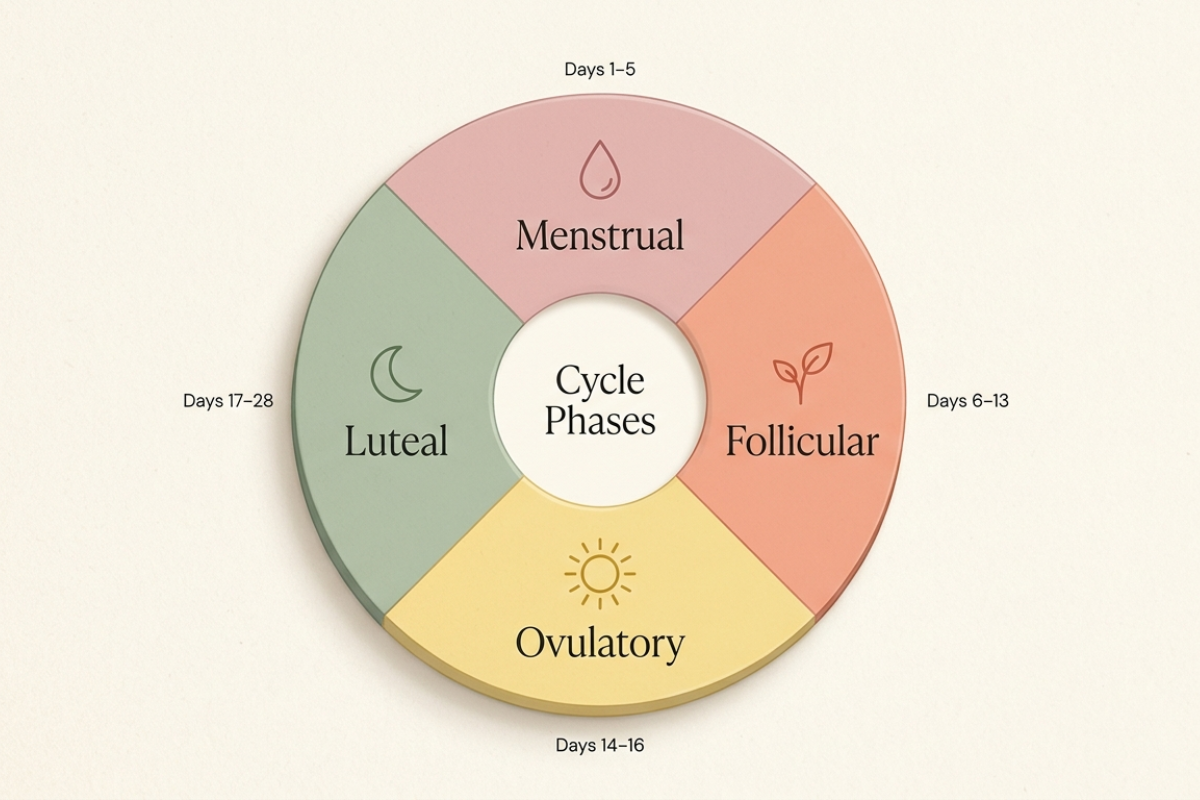
Cycle syncing breaks the menstrual cycle into four phases and recommends matching your activities to the hormonal patterns of each:
Menstrual phase (roughly days 1 to 5).
Your period itself. Oestrogen and progesterone are at their lowest. Energy is often lower, particularly in the first couple of days. Recommended approach: rest, gentle movement, restorative food.
Follicular phase (roughly days 6 to 13).
Oestrogen rises steadily as your body prepares for ovulation. This is typically when energy, mood, and motivation start climbing. Recommended approach: harder workouts, creative projects, social plans.
Ovulatory phase (roughly days 14 to 16).
Oestrogen peaks, testosterone rises briefly, and an egg is released. Many women report feeling at their most energetic and confident. Recommended approach: peak-effort workouts, big meetings, important conversations.
Luteal phase (roughly days 17 to 28).
Progesterone rises and then drops sharply if there's no pregnancy. Energy often dips, particularly in the last few days, and PMS symptoms can kick in. Recommended approach: steadier exercise, more carbs, less ambitious scheduling.
That's the framework. Now for the evidence.
What the research actually supports
Energy and mood do vary across the cycle.
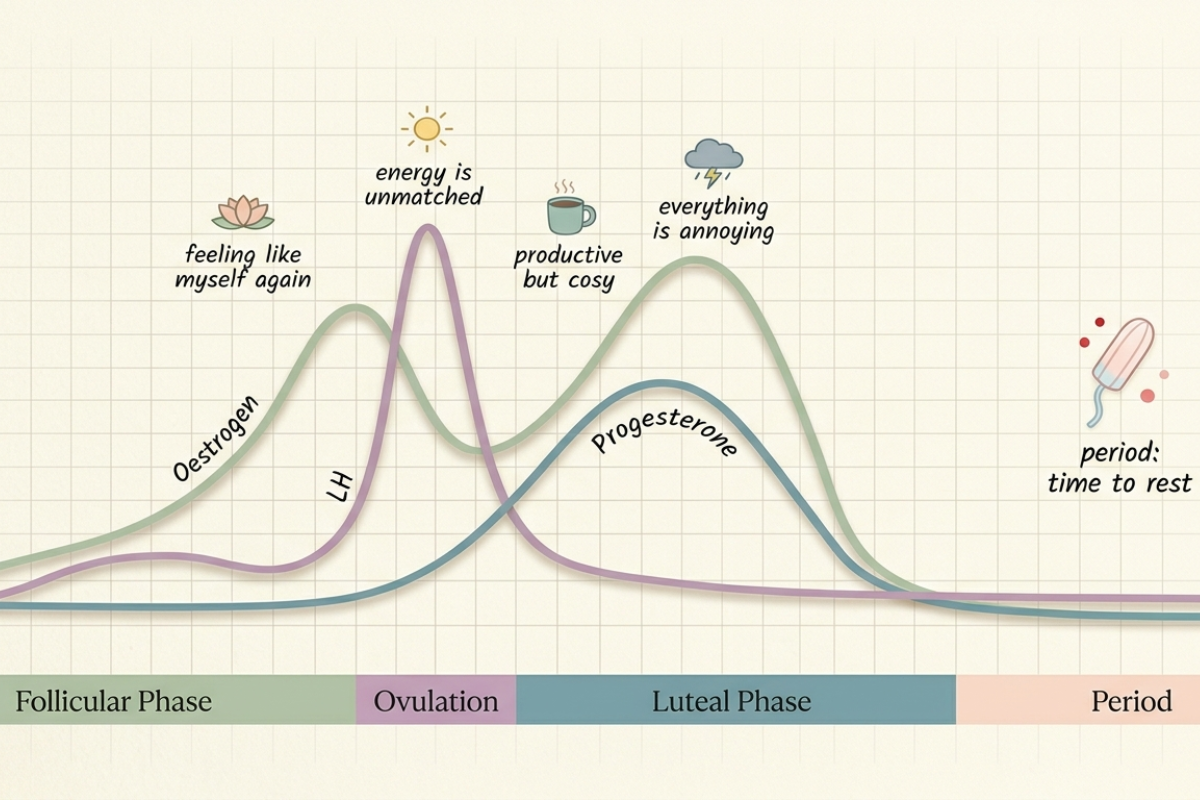
This is the strongest claim, and it holds up. A large study using a menstrual tracking app found positive moods, sex drive, and energy peaked around the fertile window, while fatigue, low mood, and physical symptoms clustered in the late luteal phase. Smaller studies have found higher cheerfulness, focus, and energy mid-cycle compared with the early follicular phase. Most women already know this from lived experience, but the data backs it up.
Hunger and food preferences shift.
Research suggests that calorie intake tends to rise modestly in the luteal phase, and cravings for carbohydrate-rich foods are real, not imagined. Iron loss during your period is also genuine, which is why leaning into iron-rich foods around menstruation makes practical sense regardless of whether you call it cycle syncing.
PMS symptoms can be managed with food.
Anti-inflammatory eating patterns, magnesium-rich foods, and omega-3s have decent evidence behind them for reducing menstrual pain and PMS severity. This isn't really cycle syncing so much as "eat well in your luteal phase," but it overlaps.
What is overstated or not yet proven
Tailoring workouts to phases for better strength gains.
This is one of the most popular cycle syncing claims, and it's the one with the weakest evidence. A 2025 study from McMaster University found that resistance training in the follicular versus luteal phase had no measurable impact on muscle protein synthesis, the process behind muscle growth.
A 2023 umbrella review of meta-analyses concluded it is "premature" to claim hormonal fluctuations meaningfully affect strength performance or training adaptations. A separate 2020 systematic review found cycle phase didn't significantly change exercise performance for most women. The Harvard T.H. Chan School of Public Health put it plainly: "There isn't enough evidence to say that your hormone levels should change your exercise plans."
Detailed phase-specific eating plans.
The idea that you need different foods (seeds, supplements, specific protein amounts) in each of the four phases is largely extrapolation. A balanced diet rich in whole foods serves you well throughout the month. Beyond the iron and anti-inflammatory points above, the evidence for highly prescriptive cycle-syncing menus is thin.
Scheduling work and creativity around phases.
There's no good research showing that you'll be more creative in your follicular phase or worse at meetings in your luteal phase. Cognition does fluctuate slightly across the cycle in some studies, but the effects are small and inconsistent.
Injury risk.
Some evidence suggests joint laxity changes around ovulation, which may slightly raise injury risk in elite athletes. For most people exercising recreationally, this isn't something to plan your training calendar around.
A low-commitment way to try it
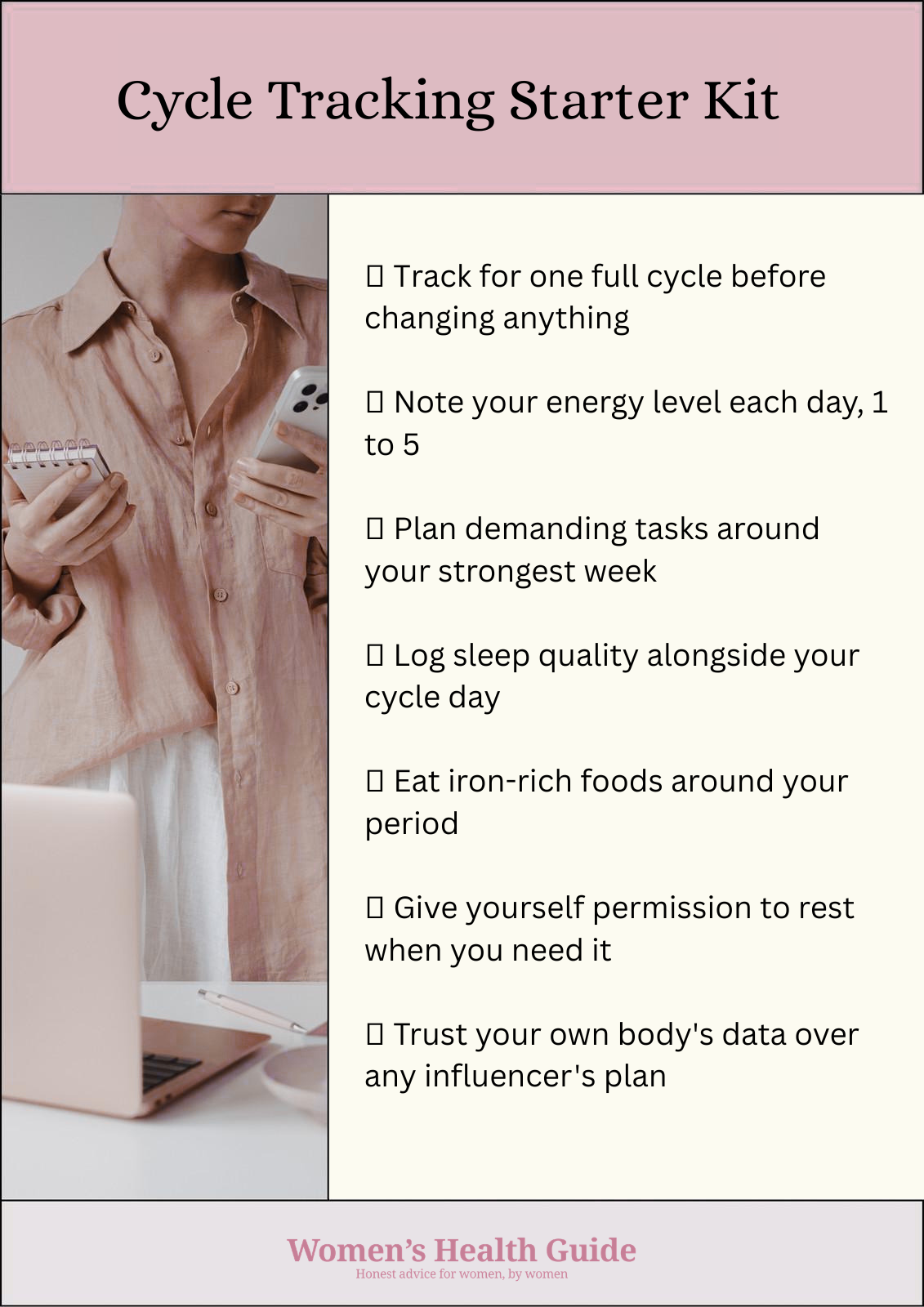
If you're curious, the genuinely useful version of cycle syncing is much simpler than the social media version: track your own patterns before changing anything. Spend one full cycle (roughly four weeks) noting a few things each day in your phone or a notebook:
Energy level (1 to 5)
Mood
Sleep quality
Workout intensity, if you exercised
Cravings or appetite changes
Any standout symptoms
Use a free cycle tracking app or a simple calendar. After one cycle, you'll start to see your own patterns, which may or may not match the textbook description. Some women feel sluggish on day one and fine by day three. Others feel rough through their whole period but supercharged ovulating. Plenty don't notice strong patterns at all, particularly on hormonal contraception.
Once you know your patterns, small adjustments are easy. Schedule the demanding workout for the day you usually feel strongest. Plan the busy social weekend mid-cycle if that's when your energy peaks. Give yourself permission to do less in the days when you reliably feel rough. None of that requires colour-coded meal plans or supplements.
The bottom line
Cycle syncing as a broad concept (working with your body's rhythms rather than against them) is reasonable and probably helpful. Cycle syncing as marketed online (specific foods, specific workouts, specific protocols for each phase) is mostly more confident than the science warrants. Track your own cycle for a month, listen to what it tells you, and trust that information more than any influencer's plan. Your body's data is more reliable than anyone else's framework.
Sources
Harvard T.H. Chan School of Public Health: Exploring exercise habits by menstrual cycle phase, 2025. https://hsph.harvard.edu/research/apple-womens-health-study/study-updates/exploring-exercise-habits-by-menstrual-cycle-phase/
McMaster University News: Researchers debunk common beliefs about cycle syncing and muscles, 2025. https://news.mcmaster.ca/researchers-debunk-common-beliefs-about-cycle-syncing-and-muscles/
Colenso-Semple et al: Current evidence shows no influence of women's menstrual cycle phase on acute strength performance, Frontiers in Sports and Active Living, 2023. https://pmc.ncbi.nlm.nih.gov/articles/PMC10076834/
McNulty et al: The Effects of Menstrual Cycle Phase on Exercise Performance: A Systematic Review and Meta-Analysis, Sports Medicine, 2020. https://pmc.ncbi.nlm.nih.gov/articles/PMC7497427/
Schmalenberger et al: A Mid-Cycle Rise in Positive and Drop in Negative Moods, 2023. https://pmc.ncbi.nlm.nih.gov/articles/PMC9856962/
Cedars-Sinai: Going With the Flow: Menstrual Cycle Syncing and Monitoring. https://www.cedars-sinai.org/stories-and-insights/healthy-living/menstrual-cycle-syncing-and-monitoring
LloydsPharmacy Online Doctor UK: Energy levels through your menstrual cycle. https://onlinedoctor.lloydspharmacy.com/uk/womens-health-advice/energy-levels-through-your-menstrual-cycle
NHS: Periods. https://www.nhs.uk/conditions/periods/
You might be interested in


No Commitment, Unsubscribe Anytime
© 2026 Women's Health Guide. All rights reserved